5 min read
Life at Scalingo: Running a Hackathon as a Fully Remote Team
Why and how Scalingo ran a Hackathon around AI with a fully remote team.
Alongside the latest updates to our platform, Scalingo recently took on a new challenge: running its very first company hackathon. Why organize one? How do you make it work in a fully remote environment? And what came out of this first experiment? Here’s what we learned.
From idea to reality
It all started with a simple question. After adding new capabilities to the platform, particularly around AI with pgvector and the k-NN plugin for OpenSearch, we wanted to see what those features could enable in practice. What better way to do that than by building real projects?
A hackathon quickly emerged as the obvious format. It gave our engineers the opportunity to explore what they could create using the platform they work on every day.
There were a couple of reasons behind that choice. We had seen similar initiatives work well in other companies, often leading to creative and impactful projects. Just as importantly, it was a chance for the tech team to step away from their usual work, experiment with new tools, and collaborate with colleagues they do not typically work with as closely.
Once the idea was clear, we shared it during one of our regular All Hands Meetings, a company-wide moment where teams reflect on the past quarter and look ahead to what is next. That is where the proposal was presented and quickly validated by both leadership and managers. From there, it was time to start planning.
Organizing a hackathon: challenges and lessons learned
The theme came together quickly: build AI-related projects using Scalingo.
As Samir Akarioh, DevRel at Scalingo, puts it:
“In practice, that could mean an application hosted on Scalingo, a project using a Scalingo database, or more broadly anything that showcases at least one feature of the platform.”
We also wanted the projects to be more than just fun experiments. The idea was to work on real use cases, either internal ones or challenges our customers actually face.
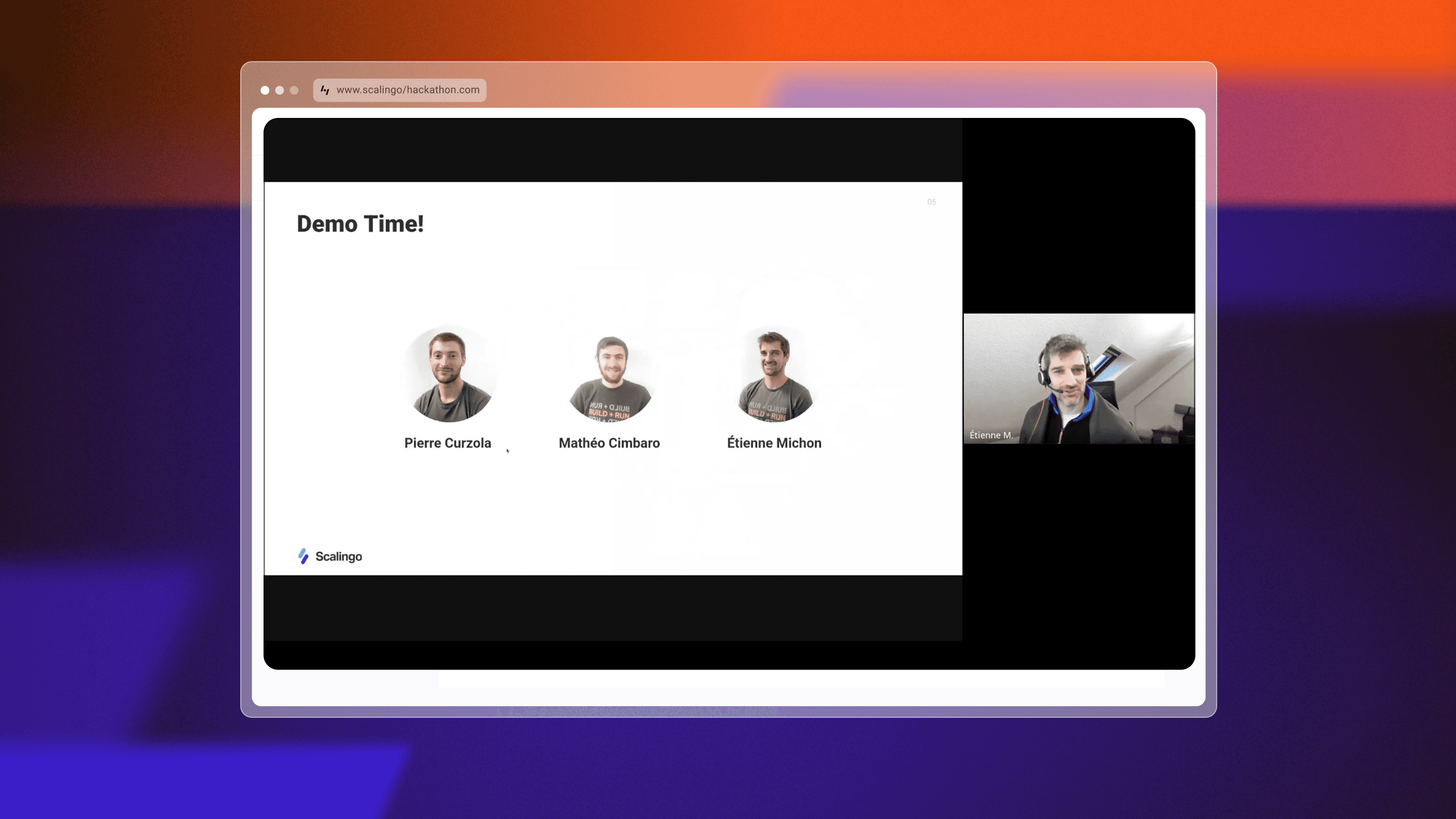
At the end of the three-day event, each team presented their project remotely, as expected in a fully remote company, walking through what they built, their technical choices, and the thinking behind them.
One of the first challenges was making sure participants could fully focus on the event. That meant freeing up time, which was no small task. Managers and HR worked together ahead of time to make sure the hackathon was treated as a priority, not something to squeeze in on top of everything else.
As Samir explains:
“We made sure early on, with both managers and HR, that the hackathon would be recognized as a priority, not just an extra activity.”
This required some internal reorganization to maintain our usual level of service, especially on the support side, without disruption. At the same time, we set a few ground rules to keep things balanced, including limiting work to normal hours so the event stayed within a healthy framework.
Security was another important consideration. As a secure cloud hosting provider, we have strict internal requirements. Our InfoSec team was involved early to make sure everything stayed compliant.
“We defined a set of guidelines to account for those constraints. It is essentially a lighter version of our production processes,” explains Matthieu Bronner, Engineering Manager.
To make things more engaging, we also set up a jury to review the projects after the presentations and select a winner, with a prize for the winning team. That said, staying true to Scalingo’s culture, every team was rewarded for taking part.
Results and feedback
Feedback started coming in as early as the kickoff meeting.
“We had initially defined a fairly detailed set of criteria,” recalls Stéphane Le Choisnier, Engineering Manager. “But right from the start, it became clear that it made things unnecessarily complex. Since this was our first hackathon, we adjusted on the fly and simplified the evaluation to avoid discouraging participants.”
One example is that using both an MCP and a vector database was originally mandatory. After discussion, that requirement was made optional.
From there, teams were free to organize themselves over the three days. Some chose to spend time exploring documentation and tutorials, especially when working with technologies they were not yet familiar with.
In the end, four AI-focused projects came out of the hackathon:
A machine learning-based “smart autoscaler”
An AI assistant capable of performing first-level diagnostics when a customer’s application encounters issues
An AI system designed to diagnose deployment and runtime problems
A project focused on identifying ways to optimize and reduce token consumption
We will be sharing more about these projects in upcoming articles.
Overall, the feedback was very positive. Leadership and managers were on board from the beginning, with a strong focus on making sure the setup worked for both the company and the people involved.
Participants, for their part, appreciated the break from their usual routine and the chance to explore technologies they would not normally work with. Cross-team collaboration was another highlight. It brought people together in new ways and pushed teams to build more ambitious, technically advanced projects by combining different areas of expertise.
What’s next
This hackathon reinforced something we have already touched on in previous articles about life at Scalingo. In a fully remote company, creating shared moments outside of day-to-day work is essential. It helps build connections and keeps teams engaged over time.
And while this was our first hackathon, it will not be the last. Everyone involved in organizing it is keen to do it again, this time around a different theme.
Nothing has been finalized yet, but a few ideas are already being explored, from observability to tackling real-world challenges faced by our customers or internal teams.
We will also be publishing follow-up articles diving deeper into the projects built during the hackathon, hopefully giving you a few ideas for your own AI projects on Scalingo.

Fanny Dufour
Fanny began her career in media through video games. She then found her way to web development and became captivated by the broader issues that affect our digital lives. She is particularly drawn to exploring privacy, open-source tools, digital security, and the responsible consumption of technology.
Stay Updated
Get articles and platform updates in your inbox.
Ready to Deploy with Confidence?
Experience zero-downtime deployments, intelligent auto-scaling, and fully managed infrastructure. Start deploying your applications on Scalingo today.
No credit card required • Deploy in minutes • Cancel anytime