4 min read
How to deploy n8n on Scalingo (quick start + production setup)
Self-host your n8n instance on Scalingo's PaaS, that’s fully secure, managed, and running on our certified European cloud infrastructure.
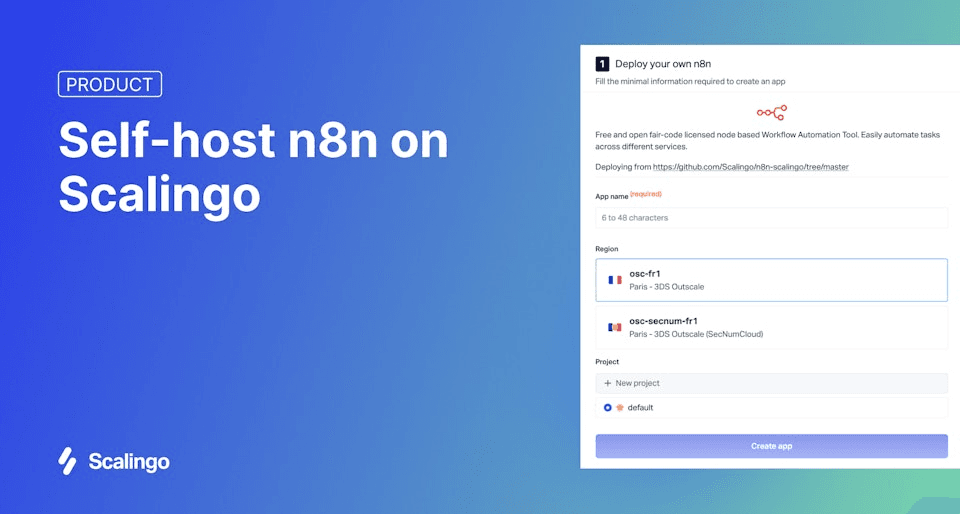
n8n offers a great hosted cloud (SaaS) version, but more and more teams are choosing to self-host for greater control, compliance, and customization.
Self-hosting an automation platform sounds simple at first. But once you start thinking about infrastructure, database configuration, scaling, and maintenance, things can quickly become more complex.
Scalingo helps simplify this process by providing a managed platform where you can deploy and run your own n8n instance on secure European cloud infrastructure.
In this guide, we’ll look at what n8n is, why teams choose to self-host it, and how you can deploy it on Scalingo.
⚠️ Note: The deployment template available for n8n on Scalingo is intended as a quick starting point. For a fully production-ready deployment, we recommend following the detailed setup guide in our documentation.
What is n8n? (and why we love It 🫶)
n8n is an open-source workflow automation tool that helps connect your apps, APIs, and services without having to wire everything together with custom code. It’s a bit like sketching out how your tools should talk to each other, then watching them actually do it.
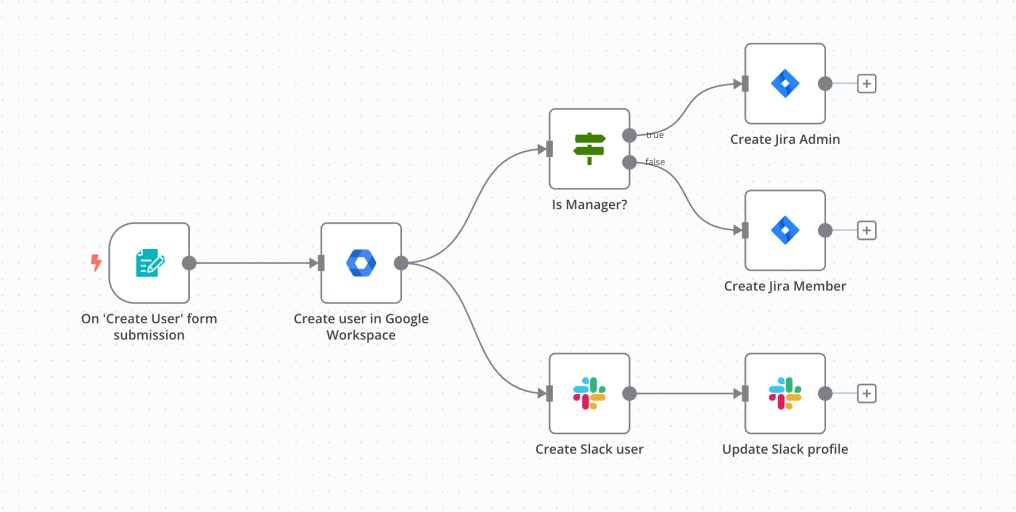
With n8n, you build workflows visually. Each node represents an action, like pulling data from an API, cleaning it up, or sending it somewhere else. When you link a few of those together, you’ve got an automation that quietly takes care of the repetitive stuff for you.
Some workflows are simple “if-this-then-that” setups, while others can run complex multi-step processes that save hours every week.
This is an example of a simple workflow (source : n8n):
What we really like about self-hosted n8n is how flexible and open it is. It’s not a closed-off SaaS where you hit limits or need to upgrade just to try something new. You can host it yourself, extend it, and even write your own nodes to connect with private APIs.
And because it’s open source (which, let’s be honest, is kind of our thing 😛), you stay in control of your data and your infrastructure.
--> “n8n” is short for “nodemation,” a blend of “node” and “automation.”
Why self-host n8n?
The hosted version of n8n is great for getting started. It’s quick, simple, and everything just works. But once you need full customization or more control over your data, self-hosting starts to make sense.
Running your own instance means everything stays under your control. Your data lives on your infrastructure, and you decide how it’s stored and managed. That’s why we use n8n internally at Scalingo. It reflects our values of openness, transparency, and reliability in a market where trust really matters. Plus, while competitor Zapier is still a user favorite (and an excellent tool!), n8n is proudly European 🇩🇪.
Of course, self-hosting also gives you the flexibility to build the way you want. Need to connect to a private API or experiment with a custom node? You can. n8n will simply adapt to your workflow.
As a bonus, when you run it on Scalingo, you keep this flexibility without the setup work. Your instance runs on European infrastructure, it’s easy to maintain, and built to evolve with your needs.
Deploying n8n on Scalingo
Now that we’ve looked at why self-hosting can be a good choice, let’s see how to set up your own n8n instance on Scalingo.
Because n8n requires a database and specific environment configuration, deploying it typically involves a few infrastructure decisions. We recommend following our step-by-step deployment guide, which will walk you through the full setup process.
This guide explains how to:
deploy n8n using the Scalingo CLI
configure the required environment variables
provision a PostgreSQL addon
choose container sizes depending on your workload
update and maintain your n8n instance over time
Using the Scalingo n8n deployment repository
To simplify the deployment process, we also maintain a repository called n8n-scalingo on GitHub.
This repository provides a ready-to-deploy project that can be used as a starting point when creating your application.
You can use it with:
the Scalingo CLI
Terraform
or your own CI/CD workflow
The repository helps bootstrap an n8n deployment on the platform, but depending on your use case you may still need to adjust configuration such as container size, database plan, or environment variables.
Why Scalingo + n8n is the perfect match
n8n and Scalingo share a simple goal: giving developers more freedom with less friction. Both give you the openness and flexibility to build, test, and ship ideas quickly, without getting stuck on infrastructure.
With n8n, you decide what to automate. With Scalingo, you decide how and where it runs. Together, we create an environment where you stay in control of your data and workflows while the platform quietly handles the technical side.
For developers, that combination means spending less time managing systems and more time building useful automations. It’s a practical, transparent setup designed around how teams actually work.
Get started today
We love seeing what people build with n8n on Scalingo, from clever internal automations to full-blown integrations. Why not join in too?

Jennifer Taylor
At Scalingo, Jennifer leads growth and marketing initiatives, helping shape the company’s voice in the fast-evolving PaaS and cloud ecosystem. She loves translating complex cloud concepts into clear, engaging insights.
Stay Updated
Get articles and platform updates in your inbox.
Ready to Deploy with Confidence?
Experience zero-downtime deployments, intelligent auto-scaling, and fully managed infrastructure. Start deploying your applications on Scalingo today.
No credit card required • Deploy in minutes • Cancel anytime